



Savvy Traveler · October 29, 2026
How to Pick a Cruise Cabin: Where It Moves, Where It's Loud, and Which Side Gets the View
Two cabins with the same floor plan can be a great night's sleep or a long week. Here's how we read a deck plan for seasickness, noise and scenery, and what cabin codes like V1, BM5 and Category 03 are actually charging you for.
Same floor plan, very different week
After “how bad is the Drake,” the question we get most is some version of “which cabin should I book?” And people usually mean the room: the size, the balcony, whether the bathroom has a tub. That’s the part the brochure is good at.
The part the brochure skips is where the room sits. On most ships, the same veranda layout is copied down the length of three or four decks, and those copies don’t live the same life. One is quiet and steady. One is under the pool deck. One is over the anchor. One looks out at a lifeboat. Same square footage, same furniture, different trip.
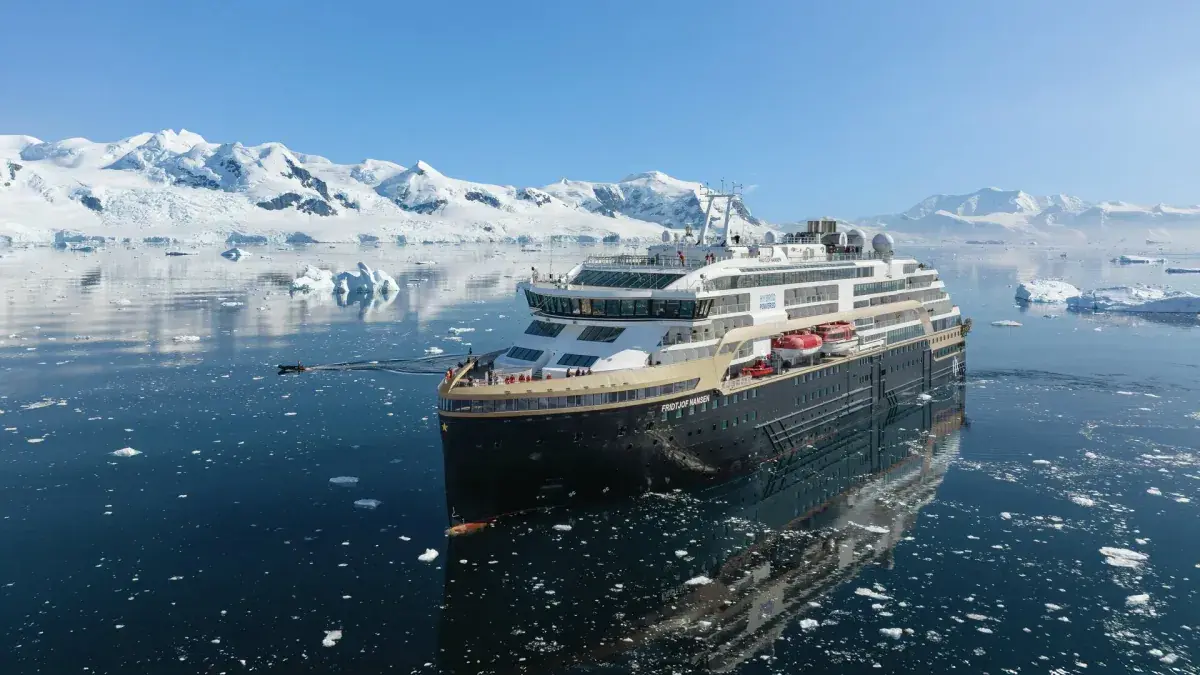
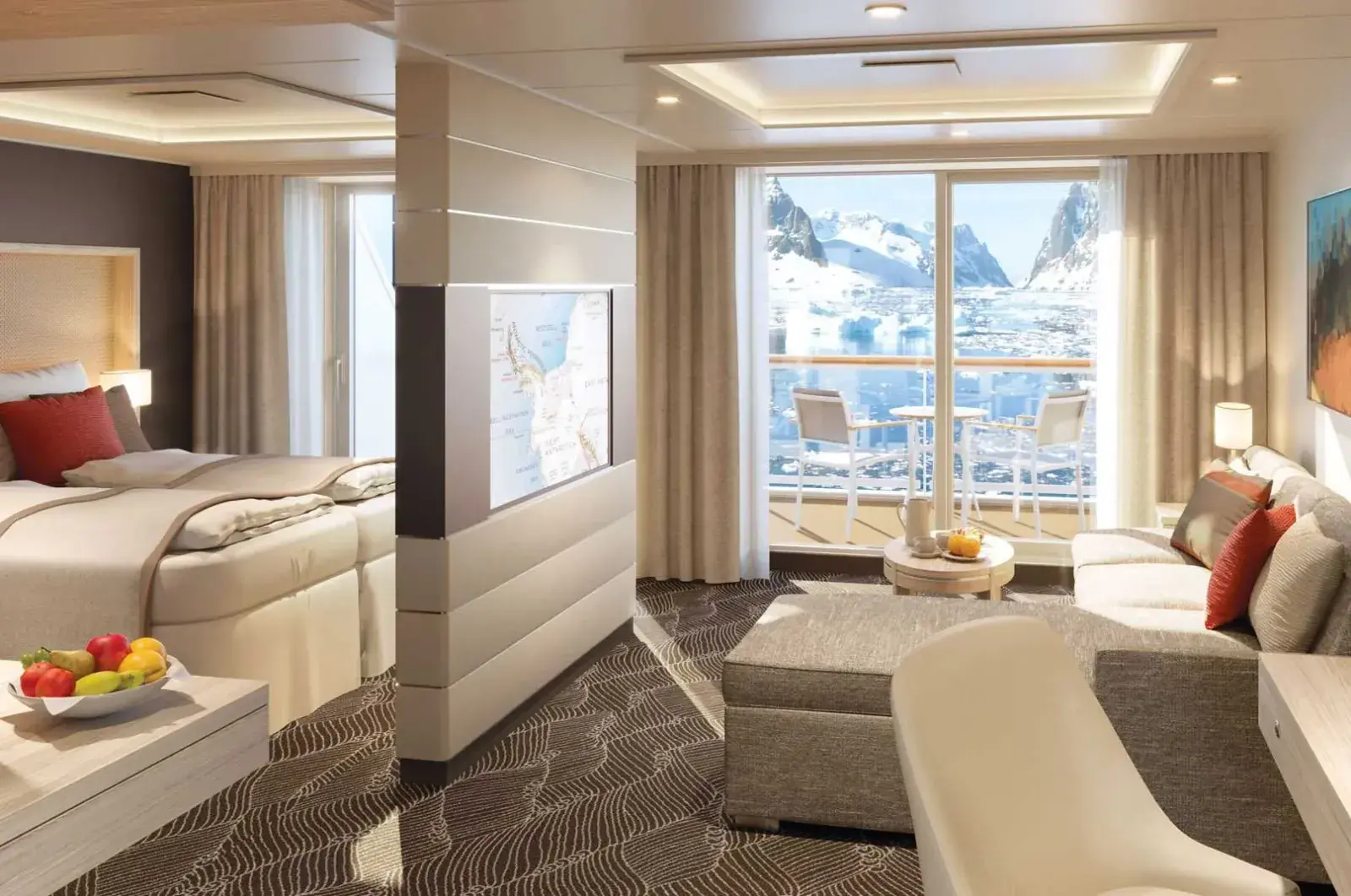
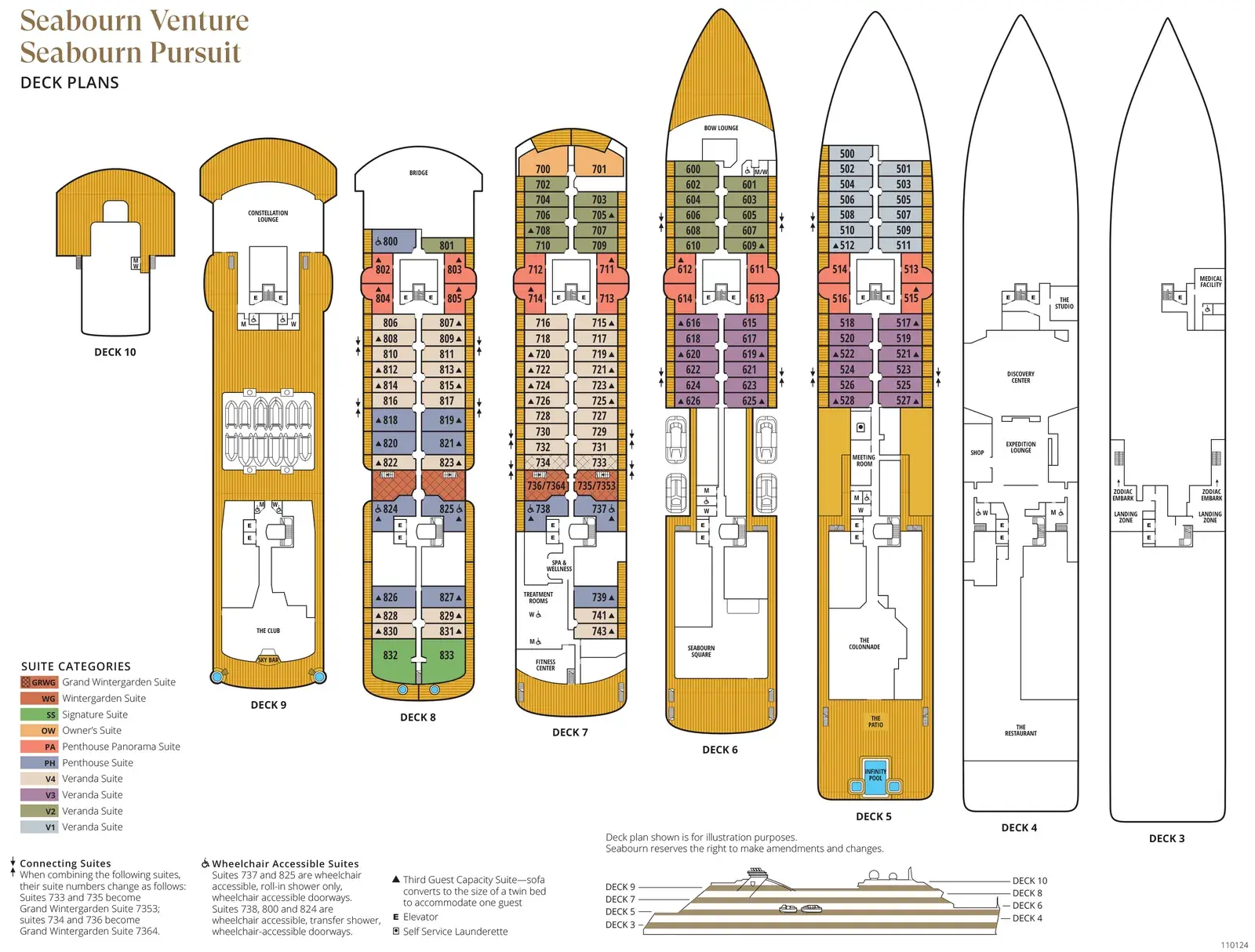
Our first expedition was aboard Seabourn’s Venture, with twenty travelers who’d signed up to join our family in Antarctica. Ours was a V4 Veranda Suite, midship on deck 7, and Erin was ready to move in: balcony views for days, a walk-in closet, and a bathroom bigger than some hotel rooms we’ve stayed in. It also had to get us across the Drake Passage, and that’s where location starts to matter more than the closet. The episode below opens on the suite tour.
Seasick? Book the middle of the ship, low down
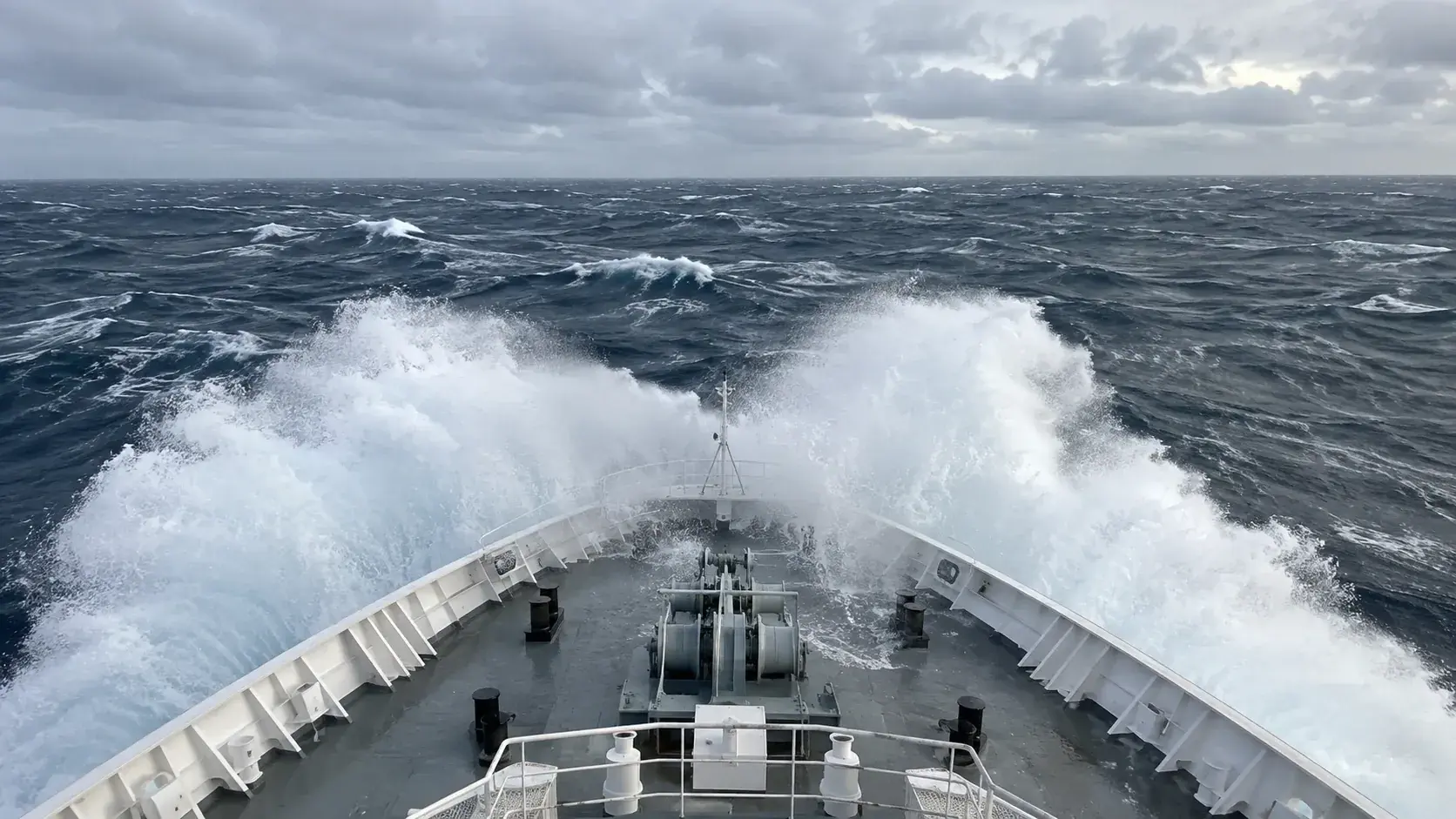
A ship moves in two ways that matter here. It pitches, nose up and nose down, like a seesaw with the pivot in the middle. And it rolls, side to side, like a metronome, which swings wider the higher up you are.
Put those together and the map is simple:
- Best: midship, on a lower or middle deck. You’re sitting near the pivot of the seesaw and near the bottom of the metronome. This is the one cabin upgrade (or downgrade) that’s genuinely about motion.
- Worst: forward and high. The bow rises and falls the most, and height amplifies the roll. Those gorgeous forward-facing suites with the wraparound windows are wonderful on a calm day and the worst seat in the house on a rough one.
- Aft: in between. Less pitching than the bow, but you’re closer to the engines and propellers, so some people feel vibration more than motion back there.
Here’s the catch: on most ships, price climbs with the deck number, so the pricier cabins up high are the ones that move more. Midship usually costs a little extra too, and for a queasy traveler that’s the premium worth paying. Paying for height isn’t.
Inside cabins deserve a note. Low and midship, they move as little as any cabin on the ship, but there’s no horizon to look at, and staring at a wall while your inner ear argues with your eyes is how a lot of people get sick. For anyone prone to it, I’d take a window or a balcony on a low midship deck over an inside cabin every time. Fresh air and a fixed horizon do real work. In our family, Colt goes green first even on flat water; on the Drake, one tiny pill was all it took.
The ship matters as much as the cabin, and here’s the good news: most of the ships we book carry stabilization systems, usually fins below the waterline that push back against the roll. A stabilized ship leans into a wave and gets pulled back upright instead of rolling all the way through it, which takes the edge off before your cabin choice even comes into it. A few ships are also built with hull shapes designed for big swell: the inverted X-BOW on Aurora Expeditions’ Greg Mortimer and Sylvia Earle, and on National Geographic-Lindblad’s Endurance and Resolution, is designed to cut through a wave rather than slam over it. We covered the rest (patches, pills, ginger, fly-cruises) in How Rough Is the Drake Passage, Really?, and the itinerary side of seasickness in I’m not a cruise person.
V1, V2, BM5, Category 03: same room, different address
You open the deck plan and three or four cabin codes share an identical floor plan. Same square feet, same balcony, same bed. So why are there four prices?
Because the code prices the location, not the room. Within one cabin type, lines slice the inventory by:
- Deck height. Higher decks almost always cost more: a better view down onto the water and a shorter walk to the lounges. (See above for what height does to motion.)
- Position along the ship. Midship usually costs more than forward or aft, for the steadier ride and the shorter walk to everything.
- The view. Cabins with a lifeboat, tender, Zodiac rack or crane in the sightline are usually the cheapest code. On expedition ships, Zodiacs live on deck, so check what’s hanging outside a given cabin.
- The neighbors. Cabins next to service areas, under busy decks or over the machinery are often priced down, quietly.
- Small extras. Now and then a slightly deeper balcony, an aft corner with a wraparound terrace, or a bit more storage.
What nobody agrees on is how to write it down. Every line has its own system, and the codes can change from ship to ship. A few from the cabins we price all the time:
- Seabourn Venture and Pursuit: the Veranda Suite comes as V1 (forward, decks 5–6), V2 (forward, decks 7–8), V3 (midship, decks 5–6) and V4 (midship, decks 7–8). Price climbs from V1 to V4, and midship counts for more than height: a low midship V3 costs more than a high forward V2.
- Atlas Ocean Voyages: on World Navigator and World Traveller, Veranda Suites V1 and V2 both sit forward to midship on decks 5 and 6, and V1 is the pricier one. Same letter, numbers running the other way.
- Swan Hellenic: the code spells out the address. BM5 is a balcony cabin, midship on deck 5; OD4 is an oceanview at the forward end of deck 4.
- Scenic Eclipse: the same Deluxe Verandah Suite is AA on deck 8, CA on deck 6 and DA on deck 5. The letters fall as the ship does.
- National Geographic-Lindblad: Endurance runs Category 01 to 05, from the Fore Deck up to the Bridge Deck, and the price climbs with the ship.
- HX: codes like RR, XT and ME mostly name the cabin type (Polar Outside, Arctic Superior, Expedition Suite) rather than the spot on the ship.
So the number on its own tells you almost nothing. A 1 is the cheapest on one ship and the priciest on the next. The patterns that do hold: higher costs more, midship costs more, and an obstructed view or an address at either end costs less. For a queasy traveler, the sweet spot usually sits in the middle of the price range: midship, but not on the top decks. On Venture, that’s the V3 rather than the V4.
Whatever the code, look at the actual cabin number, not just the category. Two cabins in the same code can still differ: one by the stairwell, one at the quiet end of the corridor.
Who’s above you, who’s below, and who’s next door
Noise on a ship travels up and down more than sideways. So before we book a cabin number, we look at three decks on the plan, not one: yours, the one over your ceiling, and the one under your floor. The usual suspects:
- Lounges, bars and the theater. Live music, the late crowd, and chairs being stacked at midnight. Being next to them is fine for some people; being directly underneath them is fine for almost nobody.
- The pool deck and the gym. Deck chairs get dragged into place at 6 a.m. and somebody drops a weight on purpose. A cabin directly below either one hears all of it.
- The galley and service areas. Kitchens start early, and carts roll through crew corridors at all hours. “Crew only” doors on the deck plan are worth noticing.
- Elevators and stairwells. The ding, the hum, and people chatting while they wait. But being two or three doors away is a gift if walking is hard, or if you need to get out on deck fast on a rough morning. Close, not next door, is the sweet spot.
- Up front, low down. The anchor chain runs out with a roar you’ll feel in your fillings, usually early in the morning. The bow thrusters, which push the ship sideways when it docks or holds position, rumble too. Many newer expedition ships hold station with their thrusters rather than drop anchor, which spares the seabed and not the forward cabins.
- Aft, low down. Engine and propeller vibration. Some people find it soothing. Others feel it in the bed frame all night.
- The mudroom. On expedition ships, the boot room and Zodiac platform see the earliest wake-up of the day. Nearby is convenient for landings and lively at 6:30 a.m.
- Connecting doors. A connecting door to the next cabin is perfect for a family and thin for everybody else.
None of this is a dealbreaker on its own. A good ship is a quiet ship, and most of these are a thump or a hum, not a party. But if you’re a light sleeper, it’s the difference between waking up rested and waking up knowing exactly when breakfast service starts.
Guarantee fares: a great deal with a small asterisk
A guarantee fare means you book the category, and the line assigns the exact cabin later, sometimes not until a few weeks before sailing. You’re promised that category or better.
The upside is real. Guarantees are often the lowest price in their category (on Atlas, the guarantee codes regularly come in under every assigned Veranda Suite), and because the line is filling the ship around you, you can be moved to a better spot or a higher category at no extra cost.
The asterisk is that you give up the pick. Most of the time the line puts you somewhere perfectly good. Now and then it’s the forward cabin on a low deck, or the one under the pool deck.
This is why Erin is a big fan of guarantees, and why we book them for clients all the time. We get very good pricing on them, and we know the ships, so we know when the risk is close to nothing (every cabin in the category is much alike) and when it’s worth a second thought (the category runs from bow to stern, or the route crosses the Drake). If you’re a light sleeper or get seasick on a ferry, we’ll tell you which kind your sailing is before you commit. Most of the time the guarantee comes out ahead.
Port or starboard: book the side that faces the coast
Quick vocabulary: facing the bow, port is left and starboard is right. If you can never keep them straight, “port” and “left” both have four letters. (And no, “posh” probably doesn’t come from “port out, starboard home.” Lovely story, no evidence.)
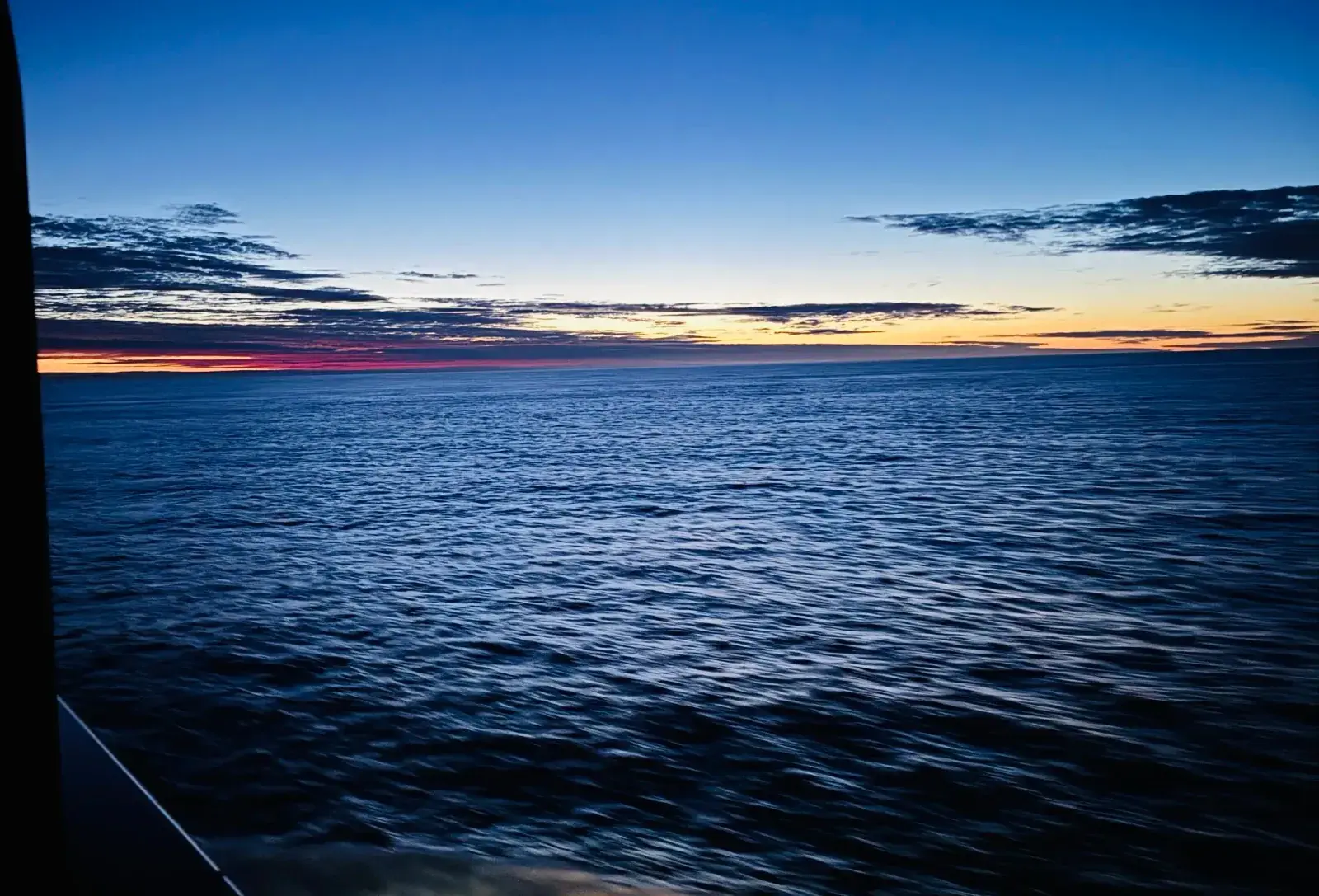
Which side you’re on only matters on a one-way route that runs along a coastline. On those, the land stays on one side for days, and the cabins on that side get the view from bed. The method is easy: open the map, find your direction of travel, and see which side the coast is on.
- Norway’s coast, heading north: the mainland is on your right, so starboard. Heading south, flip it.
- The Kimberley, Darwin to Broome: our 10-day Seabourn Kimberley cruise sails southwest with the coast to the left, so port. Sailing the other way, starboard.
- Alaska, Juneau to Vancouver: our 7-day Seabourn Inside Passage cruise heads south with the mainland on port. Honestly, though, the Inside Passage has land on both sides much of the way, and at a glacier face the captain usually spins the ship slowly so both sides get their turn.
Then there are the trips where it barely matters. Round trips give each side the coast for half the voyage. And in Antarctica, ships wander, zigzag through channels and sit in bays with ice on every side; you’ll spend the good moments on deck or at the bow, not in your cabin. Pick that cabin for the Drake, not the view.
Two smaller things. In the tropics, a balcony that faces west in the afternoon gets hot. And when the ship docks, which side faces the pier (and the pier’s warehouse) is a coin toss nobody can promise you.
The short version, for people who skipped to the bottom
- If you get seasick: midship, low to middle deck, window or balcony, on a stabilized ship. Skip the high forward suites, however good the photos are.
- If you’re a light sleeper: check the decks above and below. Avoid cabins under the pool deck, over or next to lounges, by the galley, and far forward or far aft on the lowest decks.
- If you’re there for the scenery: on a one-way coastal route, book the side that faces land in your direction of travel. Higher decks do give a better view, at the cost of a bit more motion.
- If you’re watching the budget: ask about a guarantee fare, and ask us whether it’s a safe bet on your sailing. Otherwise, the cheapest code in a category is often the same room with a small catch. Find out what the catch is. Sometimes it’s a lifeboat; sometimes it’s nothing you’d notice.
Tell us how you sleep and we’ll pick the number
When we quote a cruise, we choose the cabin number, not just the category, and we do it with the deck plan open. Tell us whether you get queasy on a ferry, whether you sleep through anything or wake at a whisper, and which part of the route you care about seeing, and we’ll put you in the cabin we’d book for ourselves. Request a quote, or if you’d rather talk it through first, start here.
Watch
Episodes on this


Keep reading