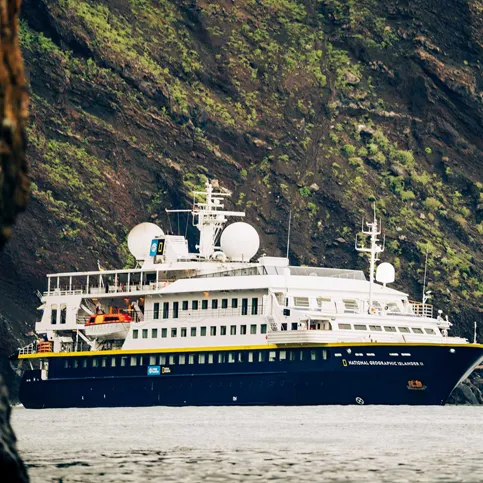
Why a Cruise May Be the Best Way to See the 2026 Total Solar Eclipse
With most of the 2026 total solar eclipse unfolding over water, cruises offer unmatched flexibility, expert guidance, and front-row viewing. Here’s how travelers are seeing totality at sea.

Quick Take
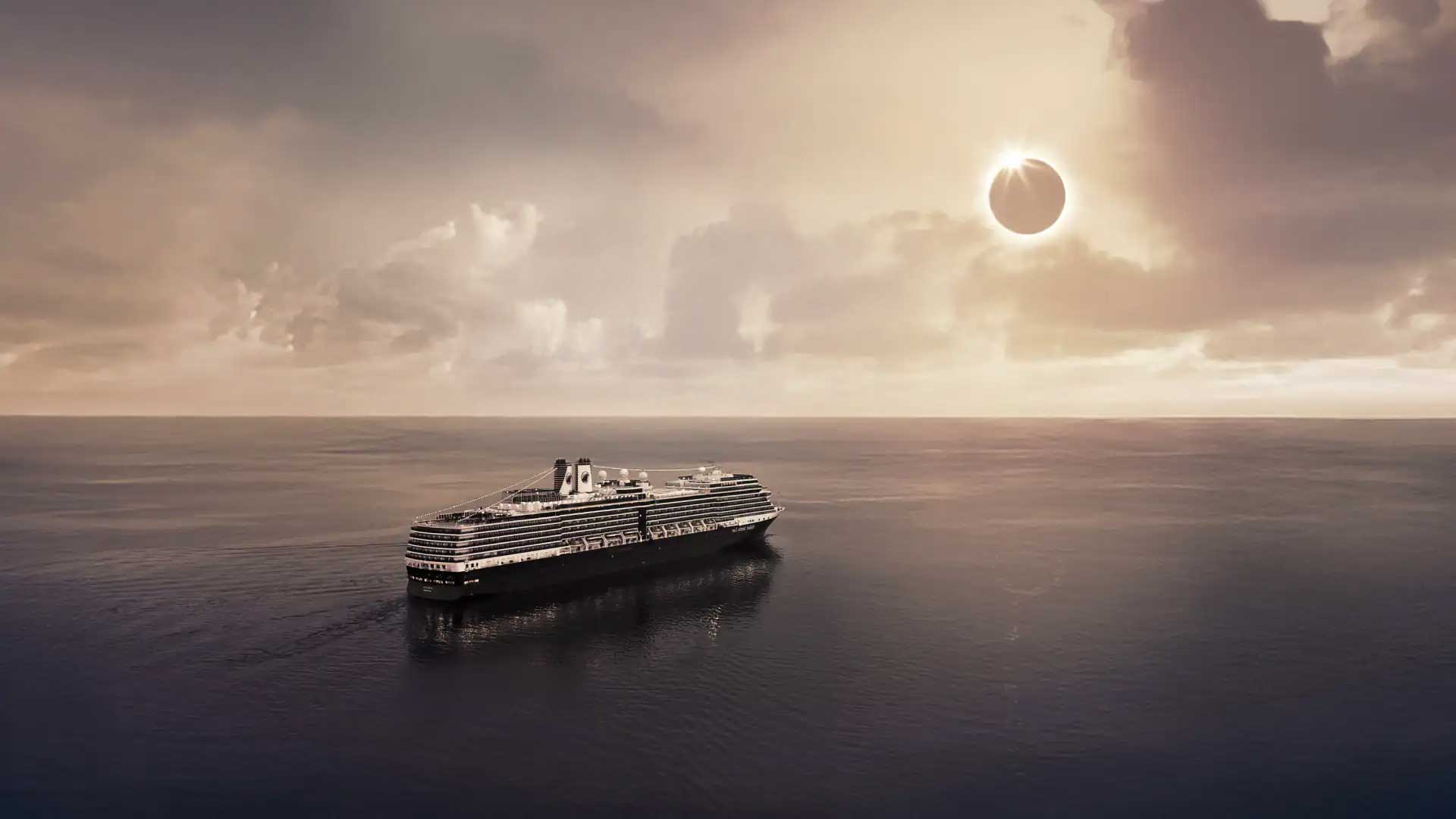
- The 2026 total solar eclipse will be largely over water, making land-based viewing unpredictable
- Expedition and ocean cruise ships can reposition in real time to avoid cloud cover
- Many sailings include astronomers, astronauts, NASA scientists, and eclipse experts onboard
- Eclipse cruises range from expedition-style Arctic voyages to Mediterranean sailings
- Demand is already strong — these itineraries will not last forever
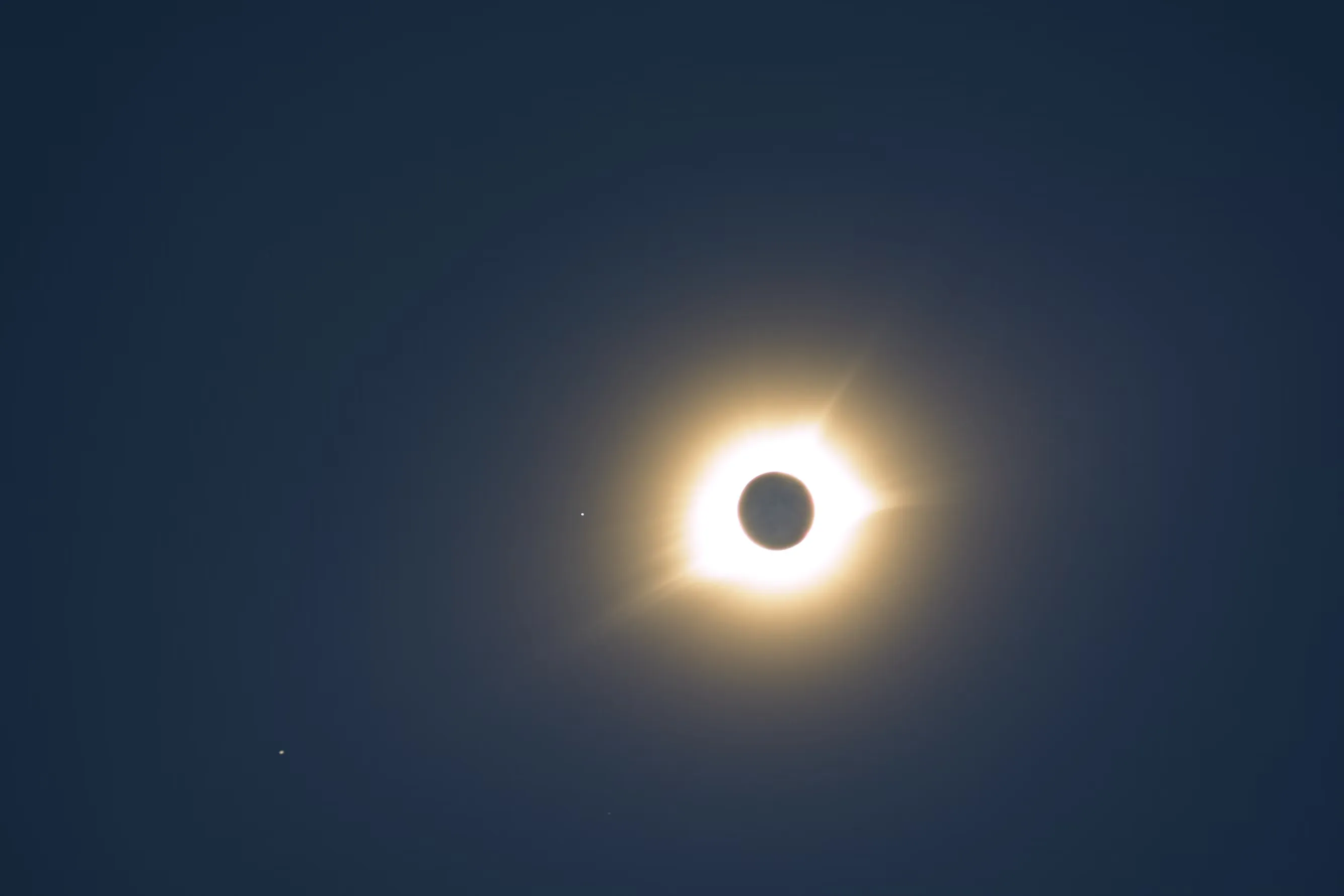
On August 12, 2026, the moon’s shadow will carve a rare and dramatic arc across some of the most remote — and beautiful — places on Earth. The total solar eclipse won’t sweep over convenient highway pullouts or major U.S. cities this time. Instead, the path of totality will pass over the Arctic Ocean, Greenland, western Iceland, the North Atlantic, parts of Spain, and the Mediterranean Sea.
In other words: water, water, and more water.
That geography changes the game entirely. And for travelers determined to experience totality — not just a partial eclipse or a clouded disappointment — a cruise may offer the highest odds of success.
Why the 2026 Eclipse Is Different
Back in April 2024, eclipse chasing went mainstream. Tens of millions of people were already living within the path of totality across the U.S., Canada, and Mexico, and millions more traveled to cities like Austin and Montréal for front-row seats.
The 2026 eclipse is the opposite experience.
Instead of cities and highways, the shadow will skim across:
- Greenland’s icebound coast
- Western Iceland
- The open Atlantic
- Portions of Spain and the Mediterranean
That remoteness is precisely why cruise lines have leaned in so aggressively. On land, you’re locked into one viewing point. At sea, you’re not.
Why Ships Have the Advantage
Few people understand eclipse logistics better than Michael Zeiler, eclipse cartographer at EclipseAtlas.com and a veteran of multiple eclipse cruises dating back to the 1990s.
His reasoning is straightforward — and hard to argue with:
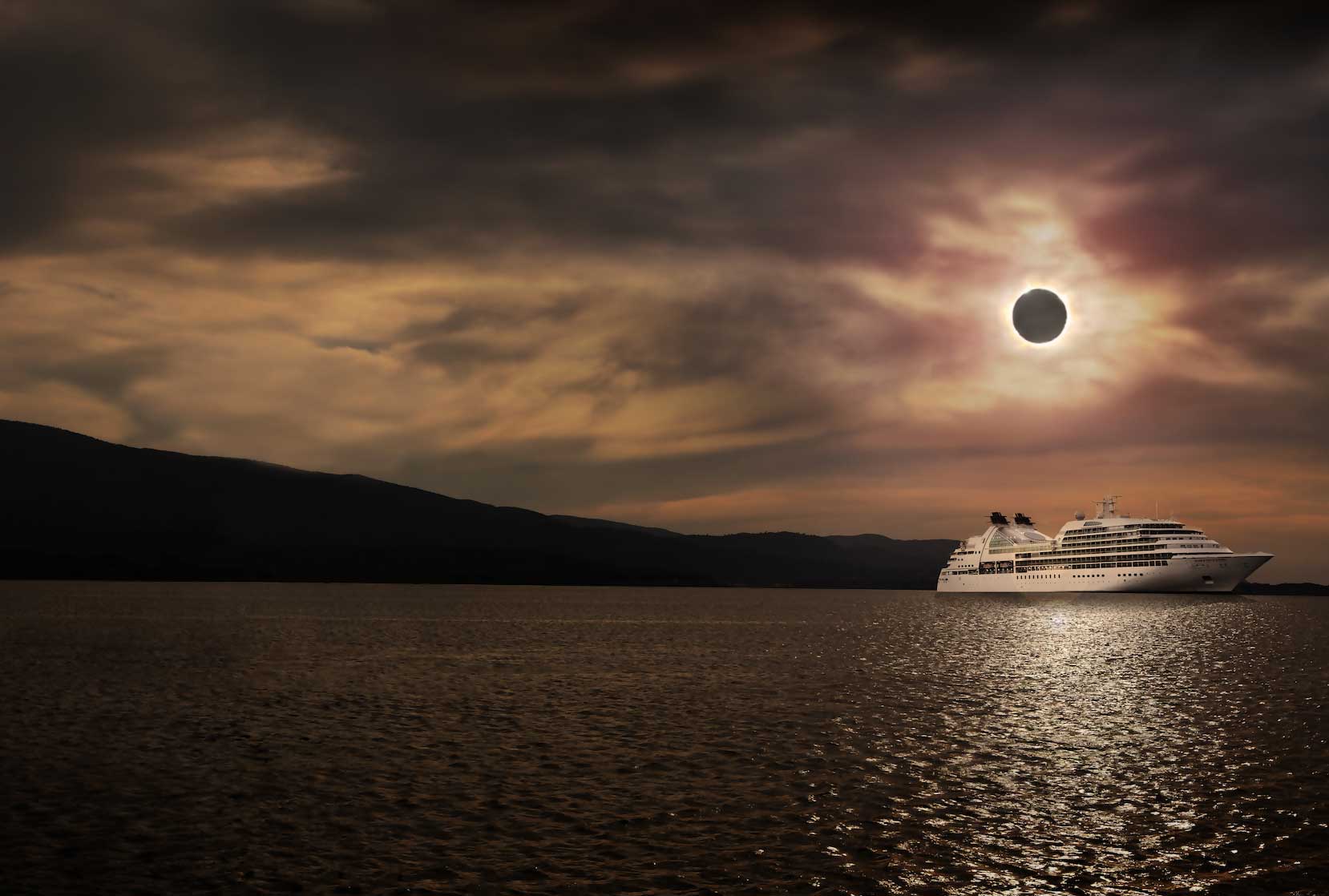
- Mobility: Ships can reposition hours before totality to chase clear skies
- Weather analysis: Professional forecasting teams monitor cloud cover in real time
- Expert guidance: Onboard astronomers explain what you’re seeing — and how to photograph it
- Community: Eclipse cruises attract fellow umbraphiles (dedicated eclipse chasers), creating a shared sense of occasion
As Zeiler puts it, it’s not just a viewing — it’s a floating observatory with champagne.
Suggested Trips
Expedition Cruises: Front-Row Seats in the Arctic
For travelers who want the most dramatic setting possible, Arctic and sub-Arctic expedition cruises are the clear standout.
Crystal Cruises
Crystal Cruises will be celebrating the rare celestial alignment as the moon interrupts the golden hour over the North Atlantic. From the pirate legends of France to the light of Lisbon, join NASA astronauts for a luxury voyage built around this single, impossible moment.
- 12-day / 11-night voyage on the Crystal Serenity
- Visits the Netherlands, Portugal, France, and Spain
- Witness the eclipse from the deck of the ship off the coast of Portugal at approximately 8:30pm
HX Expeditions
HX’s 17-day Solar Eclipse Expedition sails from Svalbard to Reykjavík aboard MS Spitsbergen, with experts from NASA, Space.com, and astronomie.de onboard.
Expect deep dives into:
- Eclipse science
- Astrophotography
- The history of celestial observation
Aurora Expeditions
Aurora is positioning multiple ships in prime eclipse territory, including:
- 15-day Jewels of the Arctic – Greenland Solar Eclipse aboard Greg Mortimer
- Hosted by former NASA astronaut Sandy Magnus, who connects space science with polar exploration
Another Aurora voyage aboard Sylvia Earle will be led by eclipse expert and science journalist Jamie Carter, in partnership with New Scientist.
National Geographic–Lindblad Expeditions
Lindblad has gone all in, offering two eclipse-specific departures:
- 12-day Iceland’s Wild West Coast to East Greenland (roundtrip Reykjavík)
- 16-day Arctic Odyssey: Iceland, Greenland & Canada, ending in Newfoundland
These sailings include National Geographic experts, photographers, and naturalists who specialize in astronomy — turning the eclipse into an educational event, not just a spectacle.
Luxury & Small-Ship Eclipse Voyages
Not every eclipse chaser wants parkas and Zodiac landings. Several luxury lines are offering more classic cruise experiences — with serious intellectual firepower onboard.
Ponant Explorations
Ponant’s eclipse sailings read like a space history conference at sea:
- French astronaut couple Claudie and Jean-Pierre Haigneré aboard Le Lyrial
- Veteran shuttle astronaut Jean-François Clervoy aboard Le Lapérouse
Routes span Svalbard to Iceland and Iceland to Ireland, positioning ships directly beneath the moon’s shadow.
Holland America Line
Holland America is offering multiple eclipse-focused voyages, ranging from 13 to 35 days, each featuring respected academics and astronomers onboard.
Ships will be positioned off:
- Spain’s coast
- Iceland
- Greenland
Depending on the itinerary, guests may witness totality from the open ocean or strategic coastal vantage points.
Mainstream Lines Are Playing Too
Even large ocean brands are adapting itineraries to ensure ships are at sea on August 12, including:
- Celebrity Cruises
- Princess Cruises
- Royal Caribbean
- Cunard
- Virgin Voyages
- Oceania Cruises
While these sailings won’t feel as expedition-driven, they still benefit from the same fundamental advantage: mobility.
Eclipse Cruises vs. Land-Based Viewing
If you’re debating whether a cruise is worth it, here’s the blunt truth:
On land, you are betting against clouds.
At sea, you are stacking the odds in your favor.
Ships can move hundreds of miles overnight to chase clear skies — something no hotel booking, rental car, or scenic overlook can match. Add in expert narration, unobstructed horizons, and the ability to experience totality away from crowds, and it’s easy to see why eclipse cruises keep selling out.
Planning Considerations (The Sitch to Know)
A few practical notes before jumping in:
- Book early: Eclipse sailings are finite and often sell out well in advance. Get a quote →
- Cabin choice matters: Mid-ship, open-deck access is ideal for viewing
- Flexibility helps: Expedition itineraries may shift routing for weather optimization
- Points & perks: Some travelers offset costs using premium cards and strategic redemptions (worth revisiting our travel perks credit card guide if that’s your jam)
Who These Trips Are Best For
Eclipse cruises are especially appealing if you:
- Missed the 2024 eclipse and don’t want regrets again
- Enjoy learning why something is happening, not just seeing it
- Prefer fewer crowds and a shared, intentional experience
- Want a once-in-a-lifetime moment wrapped inside a genuinely great trip
As the old proverb goes: The best seat in the house is the one that can move.
Summary
The 2026 Total Solar Eclipse will be one of the most geographically challenging eclipses to view in decades — but that challenge is exactly what makes cruising such a compelling option. With the ability to reposition for clear skies, onboard experts guiding the experience, and itineraries designed around totality itself, eclipse cruises offer a rare combination of science, spectacle, and smart logistics. Whether you choose an Arctic expedition or a Mediterranean sailing, watching the sun disappear from the deck of a ship may be the most reliable — and memorable — way to experience one of nature’s greatest shows.